
 3 hours ago
12
3 hours ago
12
ARTICLE AD BOX
5 minutes ago
Corinne WheatleyYorkshire

 BBC
BBC
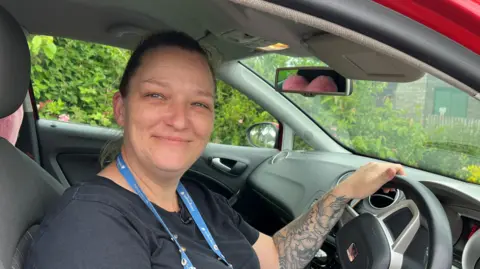
Amanda Nottingham drives hundreds of miles a week to see elderly clients
It is a "necessity" that all home care workers are paid for their mileage and travel time amid ongoing rises in fuel costs, a South Yorkshire-based carer has said.
Carers who make house-to-house calls often use their own cars for work and can drive hundreds miles a week, but not all receive support from their employers for fuel expenses.
Care industry bodies have said firms cannot afford to increase their mileage rates because they are not paid enough for their services by local authorities and NHS integrated care boards.
A government spokesperson said it was "determined to keep costs down for motorists" and was "taking action to put money in the pockets of our vital care workforce".
Amanda Nottingham, 42, said she was currently paid 35p per mile by her employer, Sheffield-based Visiting Angels.
She said she could drive between 100-300 miles (161-483km) a week to see clients and could spend up to £400 a month filling up her car.
"I probably fill up between £75-100 per week. It's a very big bill," Nottingham said.
While the mileage paid by her employer was a "massive help", that did not cover the full cost, she explained.
 NEIL HALL/EPA/Shutterstock
The cost of fuel has risen sharply since the start of the war in Iran
The price of petrol and diesel has soared since the start of the Iran war in February.
Unleaded petrol is 26.7p per litre more expensive that it was three months ago at the start of the conflict, according to the RAC's Fuel Watch.
Nottingham said she was also paid by her employer for her travel time between clients, but not all care companies did this.
"I think it should be a necessity that all carers get paid for their travel and their fuel," she said.
"We're doing a job to keep people's loved ones in their own homes, making sure they feel special and cared for.
"It's long hours. If companies are not giving fuel allowance or travel allowance, it's not an incentive to keep your staff there."
In May, Chancellor Rachel Reeves announced that tax-free mileage rates would rise by 10p to 55p per mile in a bid to help workers who used their own cars for work.
The Homecare Association, which represents care companies, said four out of five care workers drove their own vehicles for work and that 60% of providers paid their staff mileage at 40p per mile or below.
Dr Jane Townson, the association's chief executive, said many care companies could not afford to raise their mileage rates.
"Most employers pay mileage, but not many of them can manage to get to the 55p level because the income they receive from councils and integrated care boards in the NHS just is not enough," Townson said.
She added that the association had calculated the minimum price for homecare for 2026-27 at £34.42 per hour, but on average councils and the NHS paid about £24 per hour for these services.

Dan Archer said cost of living increases had a "disproportionate impact" on care workers
Dan Archer, chief executive of Visiting Angels in Sheffield, said any pressures on the cost of living had a "disproportionate impact" on home carers because of low pay.
He said he paid carers for their travel time, and was considering increasing their mileage rate following the Chancellor's announcement to help support workers.
"Pay injustice brings things like cost of living pressures into sharp relief," Archer said.
"At the moment, the system is being propped up on the goodwill of carers and they are the last people who should be subsiding this.
"So, whether the money comes from central government or local government, it is fundamentally wrong that at the moment care workers are meeting that cost by subsidising care packages themselves."
Meanwhile, there are concerns that more care workers could leave the sector because of the rising cost of fuel.
Townson said: "Some of the impacts might be that care workers are unwilling to travel longer distances, so some people in more remote places may struggle to find care."
Many people working in the industry would like to see the government make more investment in the sector, Townson added.
A government spokesperson said: "This government is determined to keep costs down for motorists and is taking action to put money in the pockets of our vital care workforce.
"That's why we have extended the 5p fuel duty cut until the end of the year, increased the recommended mileage rates that workers can claim tax free, and are delivering the first ever Fair Pay Agreement for carers – backed by £500m."
They added that during the current Parliament, care workers would receive "one of the biggest upgrades in their pay, rights and conditions in a generation, alongside our changes to the minimum wage and new measures in the Employment Rights Act".








 English (US) ·