
 8 hours ago
12
8 hours ago
12
ARTICLE AD BOX
Just now
Gill Sennett,in Hulland Paul Johnson,East Yorkshire and Lincolnshire

 Central Press/Getty Images
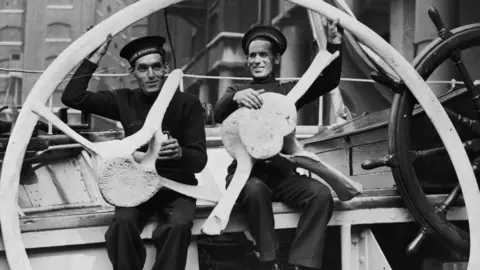
Crew members of the William Scoresby with fossilised whale bones on their return to Britain from the Antarctic in 1938
The UN has warned a new phase of El Nino – a natural weather pattern that forms in the Pacific Ocean – could begin within weeks.
Several forecasts from national weather agencies suggest it could end up as one of the strongest ever recorded and drive more extreme weather around much of the globe.
Scientists are trying to understand how this will affect the planet in an era of climate change, but efforts to understand El Nino have been going on for more than a century, as the Hidden East Yorkshire podcast has been hearing.
"There's a lot been on the news quite recently about El Nino and the effects the global impact of this warm water current in the Pacific might have on the world as it has in the past," says Dr Rob Robinson, an honorary research fellow at the University of Hull.
"That and its complementary current, the Humboldt current, the cold-water current, have been a subject of a lot of examination over the years," he adds.
"And one of the reasons we know quite a lot about it is that the foundations for our understanding of these currents in the Pacific, a lot of them were laid by a research ship called the William Scoresby."
A century ago this month, the Royal Research Ship William Scoresby set sail from Humber Dock, in Hull, on a voyage to the southern oceans.
Its mission was to conduct research on whale stocks, particularly around the Falkland Islands, and it was purpose-built in Beverley for the task.
"The Scoresby was a path-breaking ship really," Robinson says. "It was designed specifically to explore close to the Antarctic to understand more about the bottom of the seas."
Named after a well-known Whitby whaler and scientist, it was built at the shipyard of Cook, Welton and Gemmell, before being floated down the River Hull.
Its first voyage was alongside the Discovery – a famous ship that had previously carried Robert Falcon Scott and Ernest Shackleton on an expedition to Antarctica.
 Imagno/Getty Images
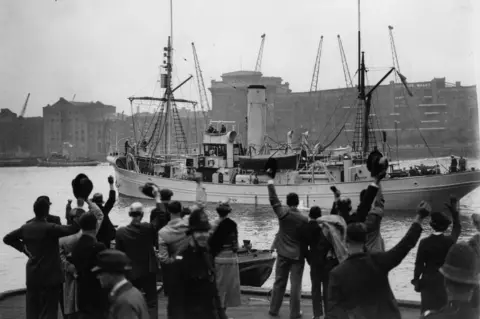
The William Scoresby is waved off from St Katharine Dock, London, in 1937
Over the course of several trips, the Scoresby began to conduct research on the movement of the oceans.
"Lots of samples were taken, tests were conducted, and gradually, with the scientists on board, an understanding, or rather the foundations of our modern sciences of marine biology and oceanography were given an extra lift," Robinson says.
During one voyage during the 1930s, when the ship was away from Britain for 19 months, the crew examined the Humboldt and El Nino currents.
"The information that came back helped with our understanding of these currents and the impact they have not only on the Pacific but on the world," he adds.
It was not the end of the Scoresby's adventures.
During World War Two, the ship was pressed into service for Operation Tabarin, which, according to Robinson, was something of a "cloak and dagger" operation in the South Atlantic aimed at preventing Argentinian claims to sovereignty of various islands within the Falkland Islands Dependencies.
A postage stamp shows the vessel in operation at the time.
The Scoresby was laid up in the 1950s and eventually scrapped, but Robinson says it left a valuable legacy.
"Our understanding, our knowledge of the frontiers of marine biology and oceanography were really consolidated by the work of the Scoresby.
"What was discovered not only helped us understand the movements of the currents and where they went, but also in a sense the way that they impacted on weather systems."






 English (US) ·