
 1 hour ago
5
1 hour ago
5
ARTICLE AD BOX
 Image source, Getty Images
Britain's Arthur Fery has never reached the fourth round of a Grand Slam tournament before
By
BBC Sport tennis news reporter at Wimbledon
It is not often you hear a Wimbledon crowd loudly imitate a ferry horn.
But the emergence of British wildcard Arthur Fery, whose surname lends itself to a range of nautical-inspired puns, has led to one of the more unusual chants at the All England Club.
"All aboard the Fery!" was a regular shout of support when the 23-year-old sunk Belgium's Zizou Bergs in a titanic five-set battle.
It was followed, naturally, by an elongated bellow.
As Fery approaches the biggest match of his career - facing Grigor Dimitrov on Centre Court in the fourth round - the world number 114 is hoping for more enthusiastic British support.
"It's awesome having so many people behind you having fun in the stands - even when it is maybe Pimms-induced," Fery told BBC Sport.
"You can feel the energy around the court and I'm hoping for the same on Monday."
With none of the other 18 home singles players going beyond the second round, French-born Fery has been carrying British hopes at Wimbledon for several days.
Attention has steadily increased on a player who had never gone beyond the second round of a major himself until this fortnight.
Playing someone like Bulgaria's former world number three Dimitrov on Centre Court will be an experience like no other.
Fery has stepped out onto iconic courts before, including Wimbledon's Court One when he faced 2021 US Open champion Daniil Medvedev in 2023.
"The biggest thing about Arthur as a person is he's really got true self-belief," said Alex Ward, an LTA men's coach who has been helping develop Fery.
"He believes, not in an arrogant way, that he can beat the players here, and goes on court with a genuine love of being in those big environments.
"He will relish being on Centre Court."
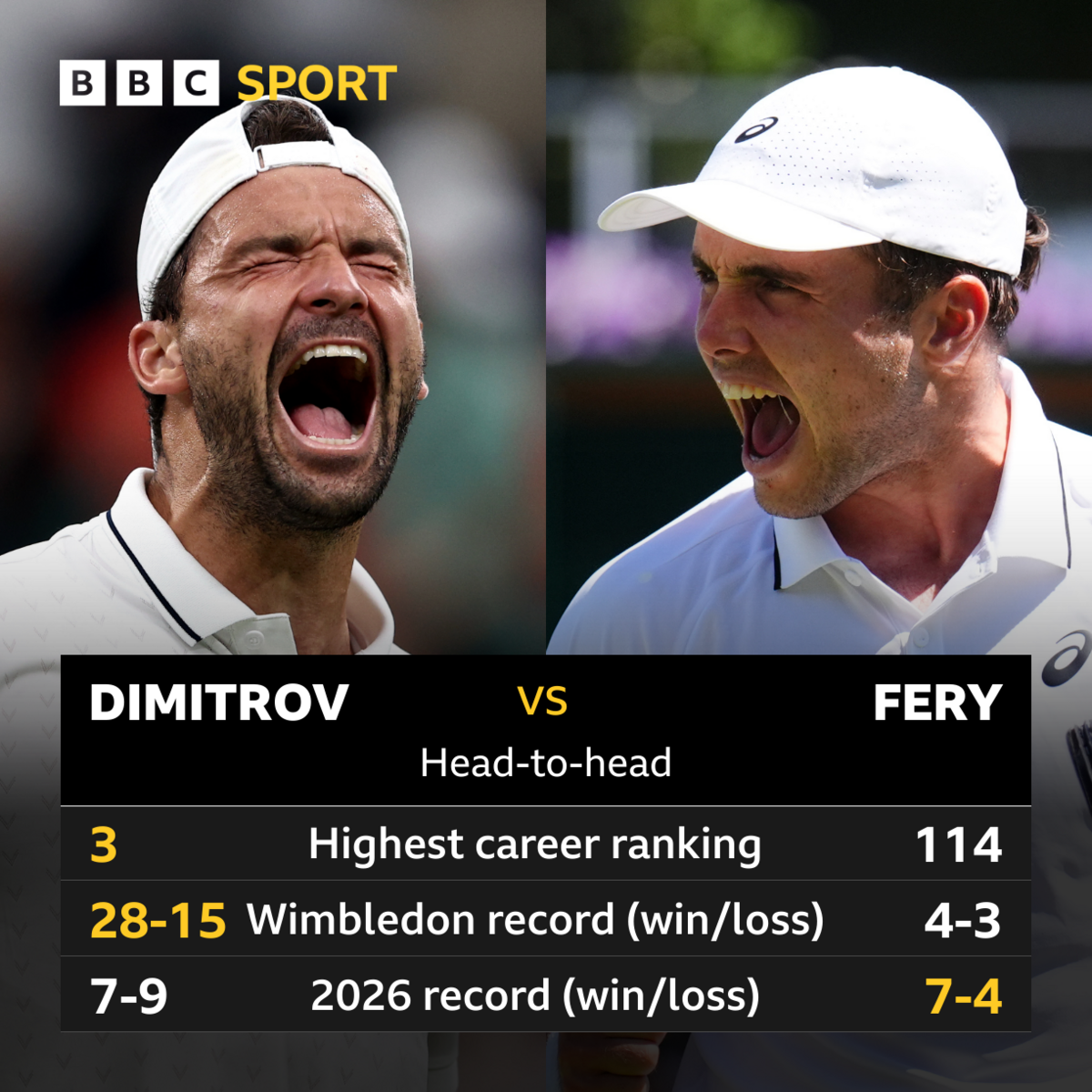 Image source, Getty Images
Fery grew up a short walk away from the All England Club, coming to the Championships most summers and trying to mimic the stars he watched.
However, there is much more to his story than just the confines of SW19.
The British men's number three was born near Paris to French parents before the family relocated to Wimbledon when he was a youngster.
After coming through the LTA system, Fery moved to Stanford University in California to study for a degree in science, technology and society - and sharpen his game with a tennis scholarship.
He delayed a full-time transition to the ATP Tour to pursue his studies, while his progress has also been limited by injuries - notably bone bruising in his arm similar to the problem affecting Britain's former world number four Jack Draper.
Fery has recovered to play 89 matches over the past two seasons and will break into the world's top 100 for the first time after Wimbledon.
"There were doubts and dark moments when my arm was really bad," said Fery, who has won 23 of his 35 matches this year.
"I didn't have many answers. But I always kept believing and trying to find solutions, even though it took a while.
"A year ago, it was completely different circumstances for me, so to be in this position now is pretty special."
How Fery has been in nosebleed territory
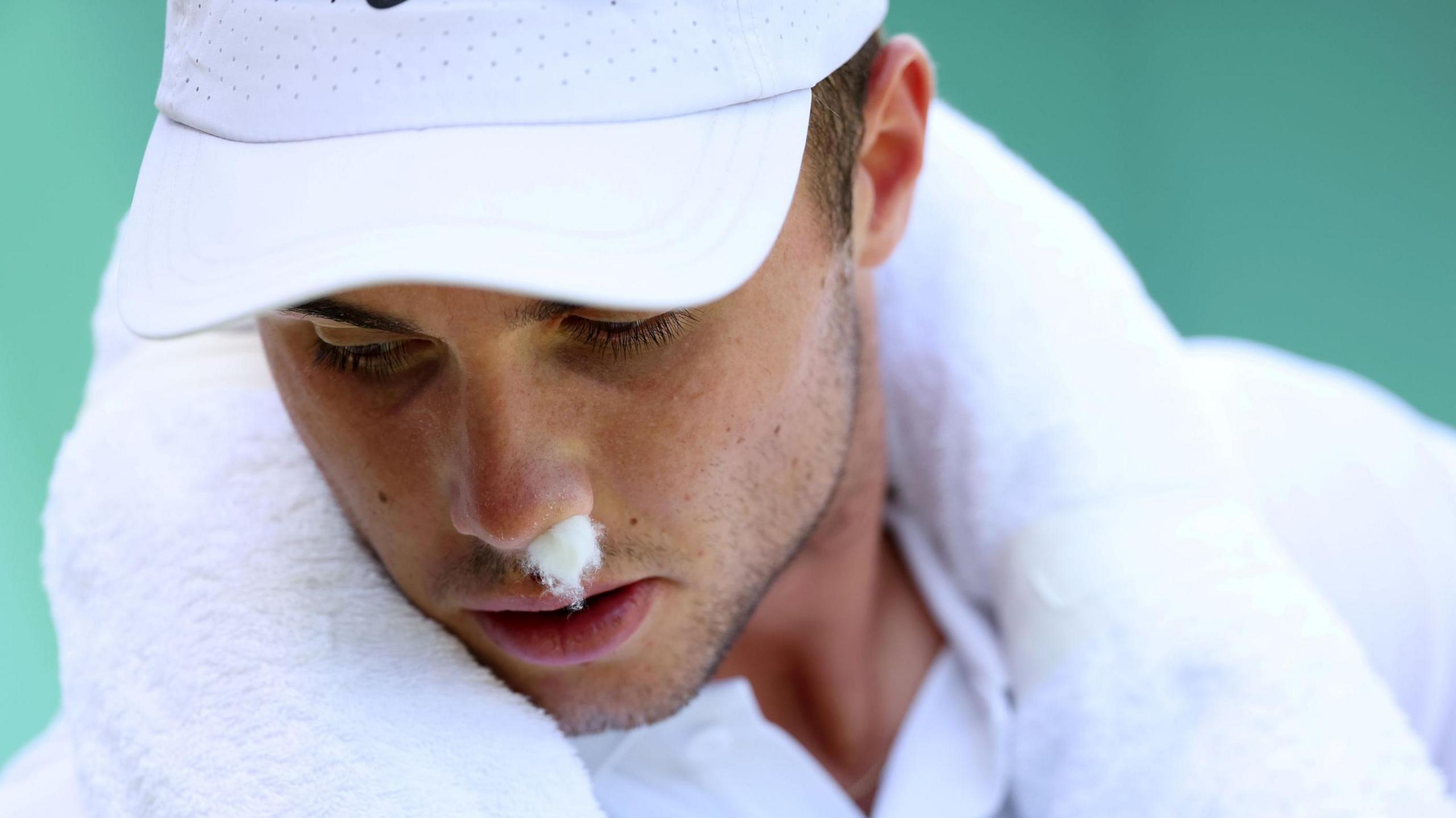 Image source, Getty Images
Against Bergs, Fery had to stop three times to stem a nose bleed, including when he was serving at 5-4 down in the deciding fifth set.
Over the British grass-court swing, there has been another unusual health issue.
Fery started suffering nosebleeds at Queen's last month and they have continued during his matches at Wimbledon.
Fery says he does not know the cause of the problem but plans to "figure it out" after the tournament.
Nosebleeds are generally caused by several factors - which include increased blood pressure, irritation from allergies like hayfever, or dehydration.
Ward suggested it might be down to the "heightened senses" Fery is feeling in what has been the most successful run of his professional career.
Jonathan Joseph, an experienced consultant ear, nose and throat surgeon, says stress can be a factor behind nose bleeds.
"In all sorts of different areas of medicine, stress makes a problem worse than it would have been - including nose bleeds," Joseph, a rhinologist at University College London NHS Hospitals and The London Clinic, told BBC Sport.
"People who are about to take a major exam, they can get a nosebleed just because of the stress. It is the same for tennis players."
Whatever Fery's issue is, he will be hoping the only nosebleed territory he experiences on Monday is the quarter-finals of a Grand Slam.
GB's Fery battles to beat Bergs in five-set thriller





 English (US) ·