
 3 hours ago
8
3 hours ago
8
ARTICLE AD BOX
9 minutes ago
Rosie BluntBBC News, South East

 Getty Images
The mothers said they were given differing advice by different health professionals
New mothers have shared their traumatic experiences of breastfeeding, saying there is a lack of support in the postnatal period.
One woman said she will not have another baby because her early feeding experiences have affected her so much.
Another said she was made to feel like a "milk-making machine" and negative experiences around feeding affected her bond with her baby.
Maidstone and Tunbridge Wells NHS Trust said it was working to ensure its advice and care was "clear, consistent and compassionate". University Hospitals Sussex NHS Foundation Trust said it was reviewing its care in order to improve.
 Jess Nicholson
Jess Nicholson had traumatic experiences breastfeeding her twin girls
Jess Nicholson from Brighton gave birth to her twin girls by caesarean in September 2025 at St Richard's Hospital in Chichester.
She said one of her babies went blue and almost suffocated when she tried to breastfeed her.
"I remember thinking I've had these babies for five minutes and I've already almost killed one," said Jess.
Jess said the ward was short-staffed, causing long waits when she rang the bell for assistance.
"It would just be my husband and I and the girls trying to figure out how to keep these little babies alive without any support," she said.
"I know I won't have another kid, because I don't want to do that beginning bit again."
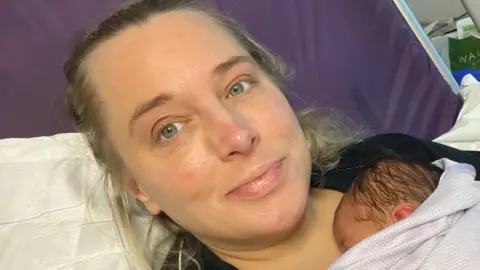 Vicki Rose
Vicki Rose said she feels robbed of the newborn period
Vicki Rose had her baby in February at Tunbridge Wells Hospital at Pembury.
She had an emergency caesarean after both she and her baby contracted an infection in labour.
Her milk was delayed coming in and she was told to triple-feed her baby every three hours.
Triple-feeding aims to increase production by breastfeeding the baby, followed by supplementing - usually by bottle - with expressed milk or formula, before pumping for 15 minutes.
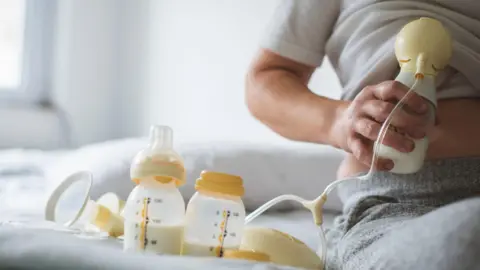 Getty Images
New mothers are often advised to express milk using a breast pump to stimulate production and increase their supply
This meant Vicki was on a schedule to breastfeed then pump every three hours, including through the night.
"There was absolutely zero preparation for how tough triple-feeding was going to be," the new mother added.
"I barely even had time to go to the toilet, let alone time to feed myself. It was just a horrible time."
Vicki said she feels robbed of the newborn period.
"I couldn't get out, which then further impacted my mental health because I was just stuck at home the whole day, clock watching," she said.
Despite her efforts, Vicki's daughter struggled to gain weight and she felt like medical staff were insinuating she was "not doing enough" and "starving" her baby.
She said staff should be better trained in how they speak to new mothers "because one comment literally can send you into a downward spiral".
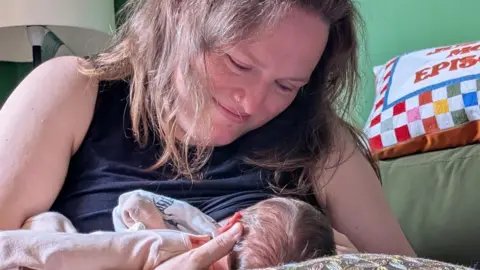 Lucy's family
Lucy said she experienced "toe-curling pain" while feeding her baby
Lucy and her husband Sean tried to educate themselves as best as possible about breastfeeding before having their baby, attending an antenatal course and an NHS virtual session on breastfeeding.
Lucy said "theory is one thing but the reality of actually breastfeeding while you're sleep-deprived, while you're going through the hormonal crash and everything like that is completely different".
She experienced "toe curling pain" when she breastfed her baby in the first few weeks.
Like Vicki, she was advised to triple-feed, which she said "really negatively" affected her mental health and her bond with her son.
"All I was doing was feeding him and then handing him off to Sean so that I could pump, so I didn't get the really nice sort of post-feed blissful cuddles.
"I was kind of just a milk-making machine."
Looking back, she said: "At no time were we asked what our priorities were and what we actually wanted from feeding."
"I have a lot of challenging memories about the immediate newborn period... I've got a lot of anxiety about that time."
'Too many different people involved'
All three mothers said they were given differing advice by different health professionals and did not feel fully involved in decisions about feeding.
Vicki also felt re-traumatised every time she had to explain her feeding journey.
"It's too many different people getting involved, because every single time you see a new person, you have to retell the entire story.
The women also said prior to giving birth there is plenty of information explaining how important breastfeeding is but not enough about the potential difficulties.
"You feel like you're making the wrong choice every time because nothing's coming easy, as it was told to you," said Jess.
Carla Mastroianni, an International Board Certified Lactation Consultant (IBCLC) based in Brighton, said feeding advice should be more holistic.
"We see this plan and no one is looking at the mother behind this plan [...] if we asked we'd know that she's not OK, she's not coping, she's drowning," said Mastroianni.
She said resources are low and training around feeding is "almost non-existent".
"In an ideal situation an infant feeding specialist should visit a woman twice a week for two to three weeks," Mastroianni said.
Jo Haworth, chief nurse for Maidstone and Tunbridge Wells NHS Trust, said she was sorry to hear of Vicki's experience.
"We understand how difficult feeding challenges can be for new parents, particularly where additional support is needed," she said.
"We are working with our teams so that the advice and care we provide is clear, consistent and compassionate for every parent."
Haworth said the trust has strengthened its support "so parents feel listened to and confident in the decisions they make".
She says the support includes help from community midwives, infant feeding cafes and help on wards from midwives, nursery nurses, volunteer peer supporters, the trust's midwifery lead for infant feeding and a dedicated infant feeding support worker.
"We will continue to focus on ensuring families receive the care they need in the postnatal period," Haworth added.
A spokesperson for University Hospitals Sussex NHS Foundation Trust said: "We're very sorry that Ms Nicholson felt unsupported during such an important time.
"We're reviewing her care and are keen to work with her and other families to understand how we can continue improving their experience.
"All our maternity staff are trained every year in infant feeding, and we've recently strengthened our breastfeeding support with new guidelines, specialist input and improved training.
"Breastfeeding initiation at our trust is almost 90%, well above the national average, and we're working towards Unicef Baby Friendly accreditation to keep improving care for families."






 English (US) ·