
 1 month ago
57
1 month ago
57
ARTICLE AD BOX
35 minutes ago
Nick RobinsonToday programme presenter
 BBC
BBC
"Do you know the result which is keeping them awake in Number 10?," a Cabinet minister recently asked me.
Scotland, I asked? Wales? No, I was told. The answer was London.
The reason Sir Keir Starmer and his team are waiting so nervously for the results of next week's council elections in London is that it represents Labour's new heartland.
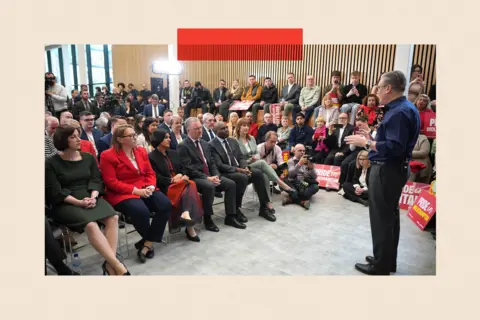
One in seven Labour MPs represents constituencies in the capital. The prime minister is a London member of parliament, as is his deputy, David Lammy, as well as the man who wants Starmer's job, Health Secretary Wes Streeting. The Secretary State for Housing, Steve Reed, completes the quartet of powerful London MPs in the Cabinet. A significant percentage of the party's activists, and the members who choose the party's leaders, live in the capital. Losses here will hurt Labour's core.
 Getty Images
One in seven Labour MPs represents constituencies in the capital
Of course, politicians from all sides are known to make dramatic claims in the run-up to elections - sometimes out of fear, and sometimes to manage expectations. But this year, virtually everyone expects serious losses for Labour in London. The pollster YouGov predicts it could be Labour's worst result in the capital for almost 50 years.
And those losses would come from a squeeze from both sides of politics. Labour is under attack from the Greens in London's progressive inner boroughs; and from Reform in the traditionally more socially conservative outer ring. The Conservatives and Liberal Democrats expect to gain some councils too.
The veteran academic of London's politics, Tony Travers, a politics professor at the London School of Economics, says the capital may be about to witness a "political earthquake".
It's a frightening prospect for Labour's leaders. And it doesn't just matter for London. It could supercharge the debate currently raging over whether Sir Keir should be replaced as prime minister. It also provides an insight into the dilemma Labour faces about which direction to take, and a warning of the fate that might await the party at the next general election.
It's all so different to the night which sealed London's place as the new power base of the modern Labour party.
Labour faced a grim day on 6 May 2010: the party lost its parliamentary majority, with big swings against it in the north, south, and Wales.
But in a corner of inner east London, it was a different story. In both constituencies in the borough of Hackney, just five miles from Westminster, the party actually increased its majority, to the surprise of those gathered at Hackney Town Hall to watch the result.
After all votes were counted, it was clear that Labour had fared much better across the capital city compared to the rest of the country. It signalled just how dominant Labour was becoming in London.
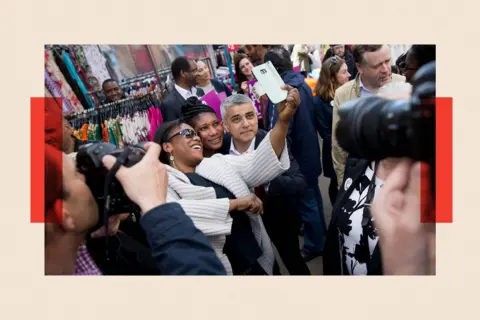
Over the next 14 years, the party strengthened its control of councils, and the Labour Mayor Sir Sadiq Khan comfortably won three elections in a row.
 AFP via Getty Images
Labour Mayor Sir Sadiq Khan has comfortably won three elections in a row
Eventually, at the general election two years ago, the party won 59 out of London's 75 parliamentary seats, wiping out the Conservatives in inner London.
This year, all 32 of the city's councils are up for grabs, along with five borough mayors.
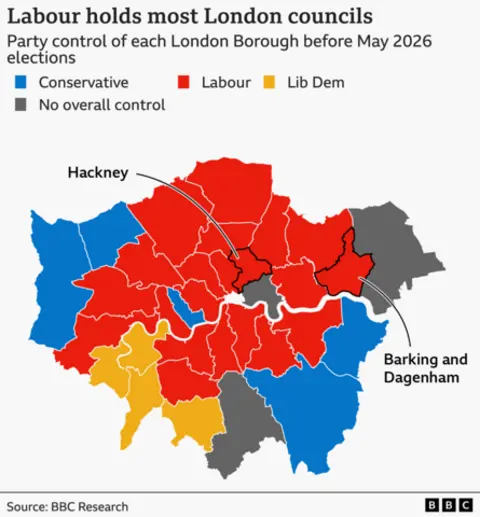
In the last set of local elections, in 2022, Labour won 21 of the councils. Now, polling by YouGov and JL Patners suggests they could be set to lose top position in a handful of them. Everyone agrees it will be a rough night for the governing party in London.
Ridley Road market in Hackney is a busy maze of open-air stalls, selling everything from spices to textiles to fresh fruit. Among its visitors earlier this month was the Green Party's leader, Zack Polanski.
The last time there were local elections in Hackney, Labour won 50 of the borough's 57 seats, and the Greens just two. But now the Greens are hoping to take this council, which has been Labour-run since the 1970s. YouGov predicts Hackney is one of the boroughs that will fall to the Greens on election night.
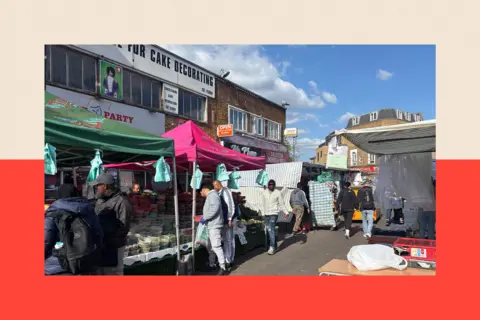
Open-air stalls at Ridley Road market in Hackney
"I feel like it's an unfair and unbalanced society at the moment," a woman tells me. She is a single parent and working full-time. She thinks Polanski "seems to have good ideas about taxing the rich", adding: "I'm really fed up with getting poorer and poorer as I get older."
An Ipsos poll from earlier this month found that just over half of Britons (54%) ranked cost of living as a "very important" issue in determining their vote at this year's elections.
Prof Tony Travers says the Greens have capitalised on voters' concern with the cost of living. "The Greens don't really talk about the environment now," he says.
The Hackney Green's manifesto has "Climate and Environmental Justice" at the bottom of the list of what it stands for, behind anti-austerity, putting workers-first, and being anti-fascist.
The Greens claim to represent the change that Labour promised but that, they argue, Sir Keir has failed to deliver. They call for a wealth tax, tougher rent controls, and 100% council tax relief for lowest income residents.
They also claim that they are best placed to block the rise of Nigel Farage's Reform UK. They say they will "defend the rights of migrants and stand up against the Hostile Environment created by politicians in Westminster".
This week Polanski has been forced to defend a list of controversial promises his party has made, such as legalising class A drugs. In Hackney, the Greens promise to push to decriminalise sex work and for an end to the "prostitute caution", a police caution given to sex workers, which the party says is "discriminatory and harmful".
They also want to end "discriminatory policing of delivery riders and drivers, recognising that many are migrants facing exploitation, harassment and unjust enforcement". The party calls for a cut in police funding as "the Metropolitan Police is institutionally racist, homophobic, sexist and misogynistic".
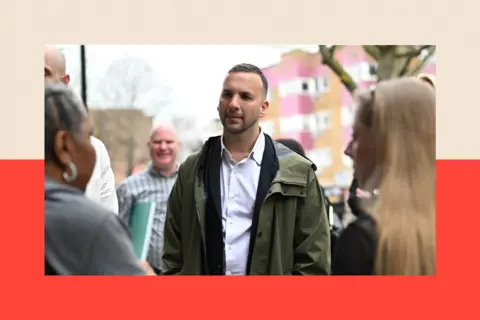 Getty Images
This week Polanski has been forced to defend a list of controversial promises
The coalition Polanski is trying to build in Hackney, and in six other target councils in inner-London, is rather like Jeremy Corbyn's: young, anti the wealthy, urban, Muslim, anti-Israel.
"I think it's a head and heart choice," another woman in the market tells me. "I think with my head it's Labour. I think with my heart it's the Greens."
A few miles further out, beyond the old East End, the challenge to Labour is very different.
In Barking and Dagenham, the primary challenge is from Reform. YouGov predicts Labour will lose the council to Nigel Farage's party.
"This area has had so much immigration in the last few years. It's changed so much," Ella tells me. I'm speaking to her at BabyZone, a hub for parents living on one of the biggest council estates in Europe: Beacon Tree.
The share of the population that describes themselves as white dropped from 58% at the 2011 census to 45% in 2021, and the borough has a relatively high number of asylum seekers as a share of its population. There are flags on many a lamp post around this area, bearing union jacks and the St George's cross.
One woman at the baby group tells me she doesn't like those flags, which she calls "racist". But still, she's unhappy with Labour. "Reform I reckon should beat Labour," she says. "Labour say they do things and don't do them. The hospitals, you can't get in there. The appointments are all up the wall."
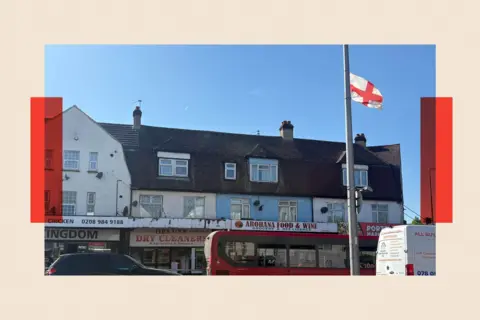
There are flags on many a lamp post around Dagenham
Ella does not object to demographic change. But many here do. "I don't think [other residents] love the change in the community. It's just an issue of people haven't integrated well together and have an understanding of each other."
Reform is making inroads into other Labour areas with white, working-class populations who are struggling to make ends meet. Again and again, the words I heard were that this place has changed and we don't recognise it.
"It's gone right downhill", Dave, who I speak to at a local pub, tells me about the area. "I've lived here all my life, went to school here. You wouldn't recognise anyone around here now.
"When you talk about immigration, people throw the race card at you - it's nothing to do with that. My granddaughter's Indian. The refugees don't want to work. Everything's a hand-out. We're working our nuts off and paying the price for what's coming into the borough."
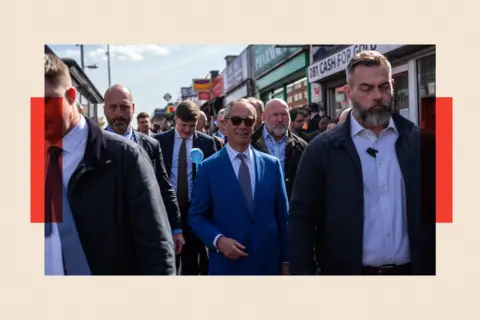 Getty Images
In Barking and Dagenham, the primary challenge to Labour is from Reform
We're just a few miles from the border with Essex, and it's the votes of what in the Thatcher era we used to call "Essex man" - or woman - that Nigel Farage's party is targeting. He is reflecting their view that the country has changed and changed in a way they don't like.
Farage is playing to the resentment voters here feel about the policies coming not just from Westminster but from London's City Hall. He's promised to give local people the chance to vote in a referendum to leave London altogether and, likely, to re-join Essex where they'll feel more comfortable.
Labour and the Conservatives
The London elections are not only a battle between Labour and the new kids on the political block. In some corners of the capital, it's a traditional fight between Labour and the Conservatives.
The Tories are likely to lose hundreds of councillors next week but they are pushing to retake three of their old strongholds - Westminster, Wandsworth, Barnet, all of which they lost to Labour in 2022. Barnet, in the northwest of the city, looks like the most achievable of those three; YouGov puts the Conservatives in the lead there, on 25%, six points ahead of Labour.
It might be the case that in areas where the Conservatives have a reputation of running a council with a low tax rate - particularly true in Westminster and Wandsworth - the party can capitalise on Labour's losses.
They hope that a few councils won might distract from an otherwise difficult night. Just as it did for Margaret Thatcher way back in 1990 when the then prime minister was facing calls to quit. She used victories in Westminster and Wandsworth to head off those calls, although those with an interest in political history may recall that she was driven out of Number 10 just six months later.
As for Sir Ed Davey's Liberal Democrats, they are polling at about the same level as they were four years ago but he needs gains to convince MPs and activists spooked by the rise of the Greens that his low-key approach is still working.
The party is hoping to build on their strongholds in southwest London by holding Kingston, Sutton and Richmond (which they currently run), and potentially winning power in Merton.
It's perhaps surprising that the Liberal Democrats aren't predicted to make a stronger advance. The party has historically done well when the two largest Westminster parties are doing badly in the polls - as they are now.
That's a sign of the fragmented nature of modern British politics. It could mean that no party wins overall control of many London councils and that parties struggle to work together and make the necessary compromises to run local services.
More than six million people can vote in next week's elections in London. That's around the same number as in Scotland and Wales combined.
The results in the capital won't only determine who runs vital public services - schools, social services and rubbish collection. They could also signal Labour's fate at the national level.
If you don't believe me, listen to the Labour Mayor of London Sir Sadiq Khan. He summed up his party's prospects in a few words: "We're in danger of being stonked."
Top picture credit: PA and Reuters

BBC InDepth is the home on the website and app for the best analysis, with fresh perspectives that challenge assumptions and deep reporting on the biggest issues of the day. Emma Barnett and John Simpson bring their pick of the most thought-provoking deep reads and analysis, every Saturday. Sign up for the newsletter here


 English (US) ·