
 1 hour ago
7
1 hour ago
7
ARTICLE AD BOX

 BBC
BBC
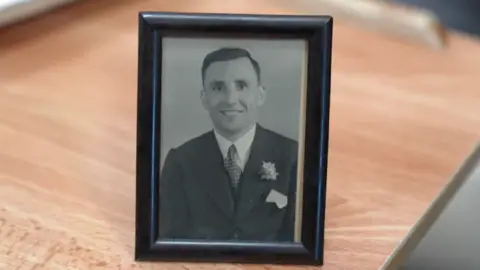
The Le Breton family held on to this picture of Soviet prisoner of war "Tom" in the hope of finding out what had happened to him
Olga IvshinaBBC News Russian
For more than 80 years, no-one knew what happened to a Soviet prisoner of war who escaped from the Nazis on the Channel Islands and spent the rest of World War Two hiding from the German occupiers with a local family.
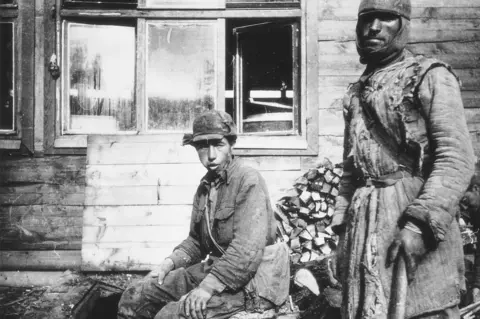
Known only by his first name, Bokejon, or simply Tom, he was one of about 2,000 Soviet prisoners and forced labourers brought to the island of Jersey to build Nazi fortifications.
After liberation, Tom and the other surviving PoWs were sent back to the USSR and although he promised to keep in touch, once he had returned nothing was heard from him again.
That was until BBC teams tracked down his descendants in Central Asia, far away from Jersey in the far east of Uzbekistan.
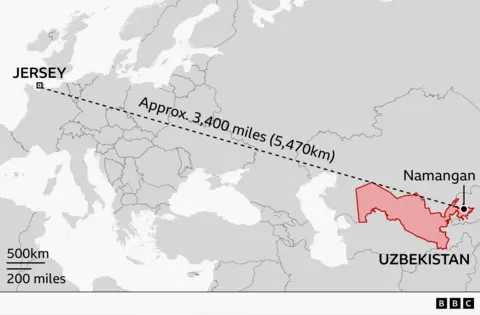
It was in 1943 that Tom escaped one of the Nazis' forced labour camps on Jersey. Exhausted, starving and desperate, he knocked on the door of local farmers John and Phyllis Le Breton. They knew the risk, but they took him in and saved his life.
Conditions in the camps were harsh.
"We were digging stone from the quarry, from six in the morning to six at night, our food consisting of soup at midday and a very meagre portion of bread and some butter at tea-time. We had no breakfast," Tom later wrote in his diary.
"For the slightest thing, we were brutally beaten… and if we could not work, we were starved and beaten again; they would never believe we were sick."
For more than two years he was hidden by the Le Bretons.
The danger was real. Another Jersey resident, Louisa Gould, was deported to Ravensbrück concentration camp, and murdered in a gas chamber for sheltering a Soviet escapee named Fyodor Burriy. Her neighbours had reported her to German authorities.
 Atlantic-Press/Ullstein bild via Getty Images
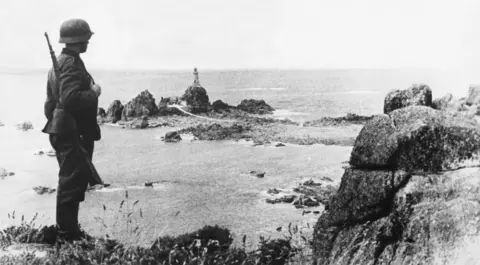
A German occupation soldier stands on the Jersey coast in the summer of 1940
John and Phyllis Le Breton trusted their escaped soldier so much that they allowed him to read to their children and play with them, including their daughter Dulcie.
"Our dear Uncle Tom, we loved him so much. He is my main memory of the war, and his photo is still by my bedside," said Dulcie, who turns 90 in June.
"But I am still mystified what happened to him after the war."
After the Channel Islands were liberated in May 1945, Tom, like other surviving Soviet PoWs, was sent back to the USSR. Three letters arrived in Jersey as he was taken home across Europe, but then there was silence.
Ex-prisoners of war who returned to the Soviet Union were typically subjected to screening and interrogation in so-called NKVD filtration camps. Soviet authorities often saw the fact of their capture as a sign of possible disloyalty or collaboration with the enemy.
Some were eventually allowed to return to ordinary life. But many were branded unreliable, faced barriers to work and advancement, and lived under a lasting cloud of suspicion.
Some were sentenced and sent to labour camps inside the USSR. Even after the death of Soviet dictator Joseph Stalin in 1953, the stigma attached to former PoWs did not disappear overnight.
 Le Breton family archive (Carolyn Horn)
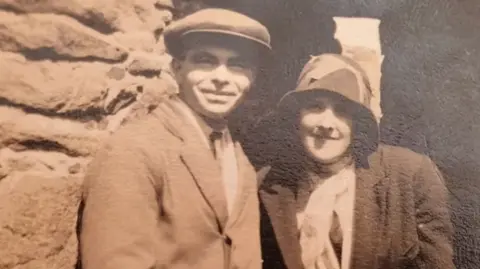
John and Phyllis Le Breton knew the very real risk of keeping the escaped PoW hidden
Tom had signed his letters to the Le Bretons as "Bokijon Akram", but neither they nor Jersey historians knew his full name or exactly where he came from.
Then a team from BBC Russian joined the search.
Even though we have worked for years on Soviet and wartime archives, this case presented a particular challenge.
Tom had signed his name in English, and it was not clear how it would have been rendered in Russian, the language used in official documents across the USSR at the time.
We checked dozens of records and hundreds of spelling variations, gradually narrowing the search using details he had recorded in his diary.
From those entries, it appeared he was about 30 when he was mobilised in 1941, had fought and been captured on the territory of present-day Ukraine, and may have had Central Asian origins.
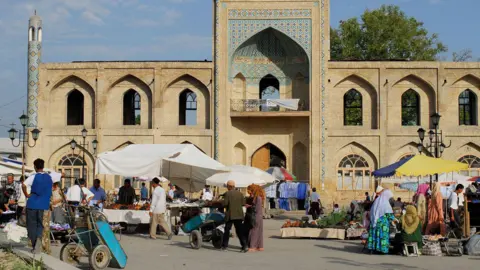
The search was then narrowed to one likely match: Bokejon Akramov, born in 1910 and mobilised from Namangan, in what is now Uzbekistan.
 Alamy
Alamy
We found an entry showing that he had been awarded the Order of the Patriotic War decades later. Crucially, that record included a home address.
At this point a team from BBC Uzbek joined the search and travelled to Namangan to check the address, hoping someone there might remember Bokejon or recognise him from the photographs preserved by the Le Breton family.
"How come you have my grandfather's pictures? Where did you get them from?" asked a man who opened the door to the BBC.
His name was Shamsutdin Akhunbaev and he was Bokejon Akramov's grandson.
As he listened to the story behind the wartime photographs, Akhunbaev was moved to tears.
According to the family, Bokejon had rarely spoken of his experiences in World War Two.
But one thing had always puzzled them. Despite clearly being intelligent and capable, he was repeatedly refused skilled or sensitive jobs. For many years, he had worked as a gardener at a factory in Namangan.
It now seems possible that his wartime captivity cast a shadow over his working life too.
Bokejon Akramov died in 1996, after what his family said was a long and happy life. His daughter has also since died.
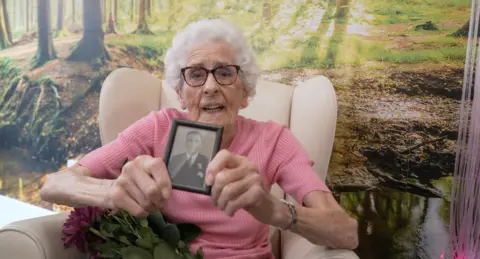
Dulcie Le Breton holds a picture of Bokejon Akramov that her family held on to since the war
The BBC helped organise a video call between his family in Uzbekistan and Dulcie Le Breton, who still lives on Jersey.
"Dear Dulcie, we thank your family for your courage and kindness," Shamsutdin Akramov told her. "Our grandfather survived the war and gave us life only because of you. We are so happy that we found you. We invite you to Uzbekistan and will always be waiting for you in our home."
"My parents did what they did simply because it was the right thing to do," Dulcie Le Breton replied. "And they were far from the only people in Jersey who helped Soviet soldiers. There were dozens of such stories, and I would very much like people to know and remember them all."
After learning of the story, the authorities in Uzbekistan decided to posthumously award John and Phyllis Le Breton the Order of Friendship - one of the highest state awards - for their "courage and compassion".
The Order of Friendship will be awarded to Dulcie Le Breton on Wednesday.
 Alderney archives
Soviet PoWs and enslaved workers in one of the camps on the Channel Islands





 English (US) ·