
 1 hour ago
8
1 hour ago
8
ARTICLE AD BOX
Watch: Captain of stranded ship in Strait of Hormuz tells BBC of 'pressure'
US Secretary of State Marco Rubio says the initial US-Israeli offensive in Iran - known as Operation Epic Fury - is over after it reached its objectives.
"We would prefer the path of peace. What the president [Donald Trump] would prefer is a deal," he told reporters on Tuesday.
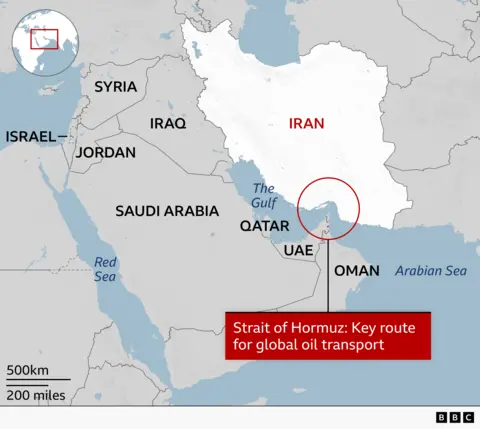
His comments come after a spate of attacks in the Strait of Hormuz raised fears the ceasefire between the US and Iran was in jeopardy. The US has said it aims to guide stranded ships out of the Gulf through the largely closed waterway.
Tehran has not commented on Rubio's statement, but Iran's parliamentary speaker Mohammad Ghalibaf earlier said: "We know well that the continuation of the status quo is intolerable for America, while we are just getting started."
Ghalibaf, Iran's top negotiator in last month's talks with the US, said "Shipping security and energy transit have been jeopardised by the US and its allies with the ceasefire violations and blockade. However, their evil acts will fail".
Late on Tuesday the UK Maritime Trade Operations (UKMTO) said a verified source had told it that a cargo vessel has been struck "by an unknown projectile" in the Strait of Hormuz. Further details were not immediately available.
Earlier in the day the UAE said its air defences were engaging missiles and drones from Iran for a second day in a row. On Monday it accused Iran of firing missiles and drones including a strike on an oil port in the emirate of Fujairah which is located outside the Strait of Hormuz, calling it a "dangerous escalation".
Iran on Tuesday denied launching any attacks on the UAE, with a military spokesman saying that, "If such an action had been taken, we would have announced it firmly and clearly".
Operation Epic Fury began on 28 February when the US and Israel launched a wave of air strikes on Iran. Tehran responded by blocking the crucial waterway through which 20% of the world's oil and liquefied natural gas usually passes.
In early April, the US and Iran announced a ceasefire under which Iran ended its drone and missile strikes on Gulf countries including the UAE, but few vessels have been able to transit the strait since then. The US also imposed its own blockade on Iranian ports.
On Monday the US said it had attacked seven Iranian fast boats in the strait while Iran said it had fired warning shots at a US vessel. Both sides denied the respective claims. Two commercial ships reported attacks and one said it had successfully exited the strait under a US military escort, as part of Donald Trump's plan to unblock the strait.
Speaking at the White House, Rubio said that while Trump wanted a deal, "That is so far not the route that Iran has chosen" adding: "What that may lead to in the future is speculative."
He said US and Israeli attacks on Iran had caused "generational destruction to their economy" and the country's leaders should "check themselves before they wreck themselves in the direction that they're going".
Rubio's comments echoed earlier remarks by defence secretary Pete Hegseth, who said the ceasefire with Iran was "not over".
"Right now the ceasefire certainly holds, but we're going to be watching very, very closely," Hegseth told a press conference on Tuesday.
Dan Caine, Chairman of Joint Chiefs of Staff, said that while Iran had attacked US forces 10 times since a ceasefire began, these attacks were "below the threshold" of resuming fighting "at this point".
Trump was later asked by reporters what would constitute a breach of the ceasefire by Iran. "You'll find out because I'll let you know," he responded. He also said he believed a negotiated settlement with Iran to end the conflict was still possible.
The various comments from American officials suggest that the US has little desire or appetite for a return to full-scale operations that could further disturb markets, send prices skyrocketing and be unpopular with large swathes of Americans.
Trump has also said he is in discussions with Japan over the strait's reopening and expects to have a positive conversation with Chinese President Xi Jinping about it when he visits China next week.



 English (US) ·