
 1 hour ago
7
1 hour ago
7
ARTICLE AD BOX
18 minutes ago
Soutik BiswasIndia correspondent

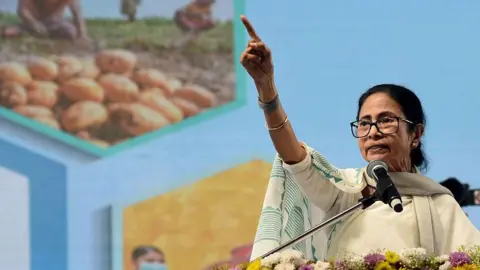 NurPhoto via Getty Images
Banerjee addresses a public meeting in West Bengal in January
For 15 years, Mamata Banerjee and her regional Trinamool Congress (TMC) party seemed to embody a political law of India's West Bengal state: they always found a way to survive.
The firebrand populist's defeat to the Bharatiya Janata Party (BJP) ended her bid for a fourth consecutive term as chief minister - a feat that would have placed her alongside long-serving regional titans such as Jyoti Basu and Naveen Patnaik.
Banerjee's loss brings one of the most remarkable political careers in contemporary India to a moment of profound uncertainty - one that began with street protests and now culminates in the weakening of the political fortress she herself built.
Dimunitive and draped in a plain cotton sari and rubber sandals, Banerjee hardly looked like a politician who would topple one of the world's longest-running elected Communist governments.
Yet in 2011 she defeated the Communist Party of India (Marxist) after 34 uninterrupted years in power, overturning a political order that had come to define West Bengal itself. The state, once India's intellectual and commercial capital, had drifted through decades of industrial decline and political fatigue.
Banerjee's rise was forged in Bengal's combative political culture, where elections often resemble prolonged street wars - her supporters called her the "fire goddess".
Born to a lower middle class family in Kolkata, Banerjee entered politics through the student wing of the Congress party. By the 1980s she had become one of the state's most visible anti-communist faces, eventually breaking away from Congress to form the TMC.
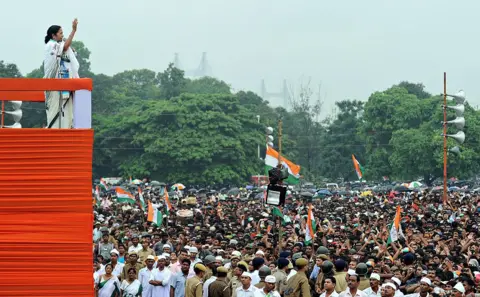 AFP via Getty Images
Banerjee addresses her supporters after sweeping to power in 2011
The violence of Bengal politics shaped her too.
In 1990, during a protest march, she was allegedly assaulted by Communist cadres and hospitalised with a fractured skull.
The episode helped forge the persona she would cultivate for decades: part street fighter, part martyr - a perpetual insurgent even in power.
Casting herself as a defender of farmers against forced industrialisation, she won fierce loyalty among rural and poorer voters. But the protests also alienated much of the urban middle class and business elite, who accused her of driving investment out of West Bengal.
"Mamata, like [Prime Minister and BJP leader] Narendra Modi, has been a politician all her life," says Mukulika Banerjee, an anthropologist at the London School of Economics.
"Her opponents were elite bhadralok Communist men - members of Bengal's educated, upper-caste middle-class elite - who looked down on her dark skin and lack of 'respectable' norms."
Her early success "only intensified her commitment to stand by the common man - squatting with vendors, arriving wherever there was trouble, dressing simply and making it her hallmark style".
"Those early battles made her fearless, realising she could make others feel the same, if she stood by them," says Mukulika Banerjee.
Everyone called her 'Didi' - elder sister - because that was the role she came to embody: "a fiercely protective figure who would lay down her life for you", she adds.
Unlike most prominent women in Indian politics, Mamata emerged without dynastic backing or a powerful mentor.
"No-one set up their own party, took on an invincible force like the Communists, ousted them after 34 years and then held power for three terms," Mukulika Banerjee says.
"And unlike other female politicians, she actively brought other women forward." (Her party fielded 52 women candidates in this election.)
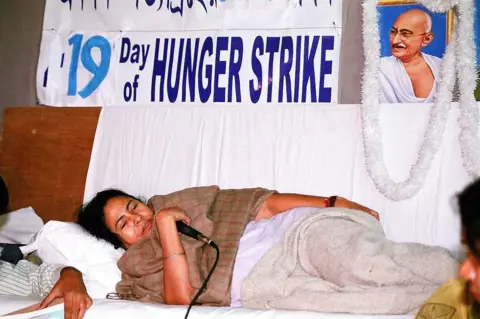 The The India Today Group via Getty Images
Banerjee during a hunger strike against plans to build a car factory in Bengal
For years, Banerjee's charisma, welfare schemes for women and the rural poor, and Bengal's strong regional identity blunted anti-incumbency, corruption allegations and the BJP's rise.
"Her success rested on a careful balance: projecting herself as both an uncompromising street fighter and an austere, maternal figure delivering welfare to those living with economic insecurity," says Proma Raychaudhury of Krea University.
Even critics conceded that Banerjee possessed an instinctive feel for the emotional grammar of her electorate.
But charisma rarely sustains political systems forever.
Political scientist Dwaipayan Bhattacharyya once described Bengal under the Communists as a "party society", where the party became embedded in everyday rural life and livelihoods.
Banerjee's party inherited this structure but transformed it. Unlike the disciplined cadre organisation of the Communists, Banerjee's party revolved around her own charisma and authority.
Bhattacharyya described the TMC as a kind of political "franchisee model": local strongmen, and grassroots leaders were allowed to expand their influence - and often their business interests - in exchange for loyalty to Banerjee.
"The franchise model has made the TMC vulnerable," Bhattacharyya presciently wrote in 2023.
"Its leaders' voracious appetite for material gains has made transactional interests undermine even a pretence of ethical politics, straining the party's bonding with the people."
Under Banerjee, Bengal was also grappling with a mounting financial crisis. The state's debt deepened, while the central bank estimated that just four of her welfare schemes for women consumed nearly a quarter of its own-source revenue.
Vacant government jobs, a major teachers' recruitment scam and growing concerns over women's safety further eroded the government's standing.
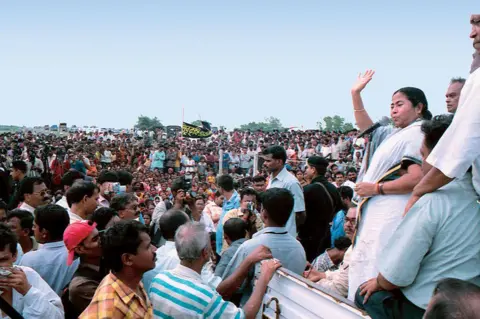 India Today Group via Getty Images
Banerjee at a public meeting to protest against the acquisition of farm land for industry by the Communist government in Bengal
Now, after defeat, Banerjee faces a different and perhaps more existential challenge: political survival.
Bengal's politics has long been unforgiving to defeated ruling parties, with leaders and local strongmen quickly gravitating to the new centre of power.
Political analyst Sayantan Ghosh says many Trinamool leaders may drift towards the BJP - some voluntarily, others under pressure - raising the possibility of a "split within the party itself".
The TMC's "apparent lack of ideological cohesion", argues Raychaudhury, could make both the party and its leader especially vulnerable after defeat.
For Banerjee personally, the adjustment may be jarring after decades at the centre of power.
"It will be a difficult phase for her," says Ghosh. "Since first winning in the late 1980s, Mamata without office or authority is something Bengal politics has rarely seen."
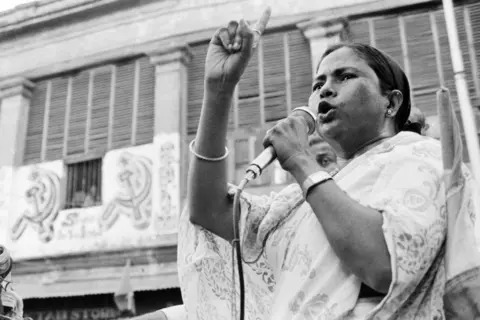 Sondeep Shankar/Getty Images
Banerjee at an election campaign for the Congress party in Kolkata in 1991
Writing the political obituary of the 71-year-old leader may still be premature. Even so, this defeat could mark a more fundamental rupture than the crises she has survived before.
Mukulika Banerjee argues that politicians like Mamata thrived in what was once a "reasonably level playing field".
That, she says, is "no longer the case" - alluding to the single-party dominance of Modi's BJP. Monday's verdict, she suggests, reflects not just discontent but that imbalance.
Which leaves some final questions.
Can Mamata Banerjee reinvent herself once more - returning to the streets as the furious outsider who first captured Bengal's imagination?
Or will she slowly become what she spent her career fighting: the fading remnant of an old political order?
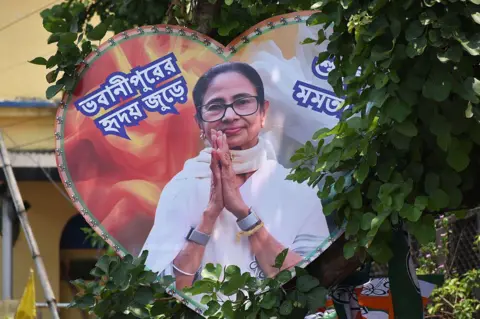 NurPhoto via Getty Images
Banerjee lost her seat from Kolkata's Bhabanipur on Monday
"Where will she go next? She knows no other life other than politics," says Mukulika Banerjee.
One possibility, suggests Raychaudhury, is a return to the politics that first made her formidable.
"Her experience of street-level oppositional politics from the Communist era could, however, see a return."
Banerjee herself already appeared to be reclaiming that role on Tuesday evening.
"I'm a free bird, a commoner now. I don't have a chair anymore," she told reporters, vowing to work to strengthen the opposition INDIA alliance nationally.
Accusing the Election Commission of favouring the BJP and warning against "one-party rule", Banerjee claimed the mandate had effectively been taken away from her party: "We didn't lose the election. They forcefully took it from us" - a charge the state's Chief Electoral Officer said he would examine "in what context" it had been made.
Then came the line that sounded most like the Banerjee Bengal first came to know decades ago.
"I can be anywhere, I can fight anywhere. So I'll be on the streets."








 English (US) ·